
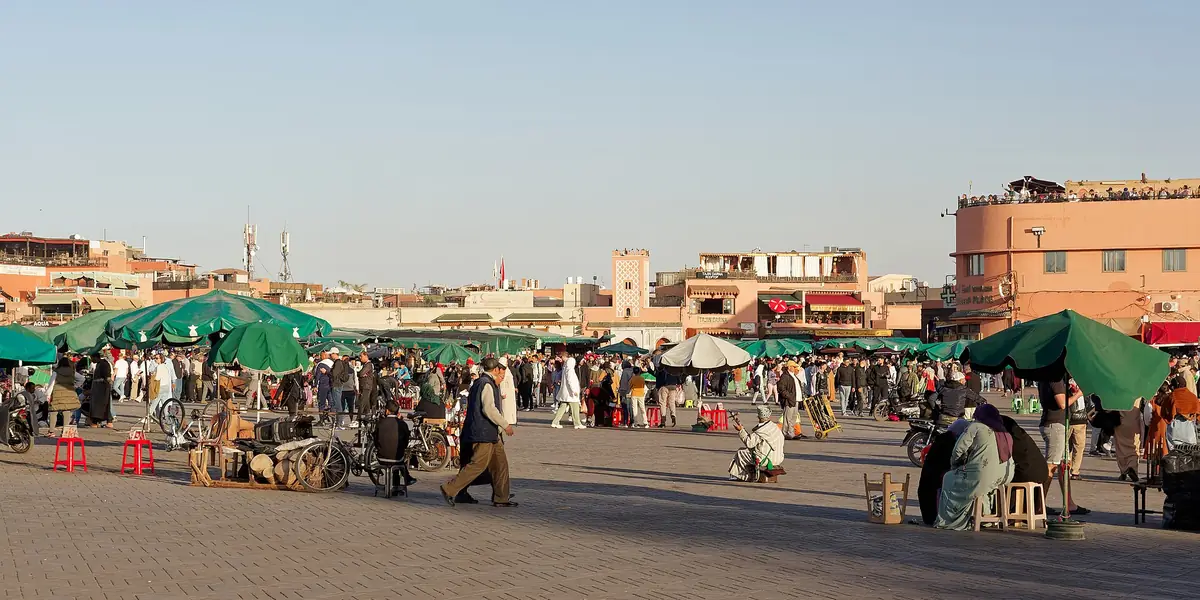
Photo: Jamaa El Fna, Marrakesh by Jakub Hałun, CC BY 4.0, via Wikimedia Commons. Resized and cropped.

Jemaa el-Fna is the square most people picture when they think of Marrakech. UNESCO describes it as one of the main cultural spaces in the city and one of its symbols since its foundation in the eleventh century. This guide sticks to what UNESCO records about the square, then adds a few practical suggestions for your visit.
What the square is
According to UNESCO, the square is triangular, sits at the entrance of the medina and is surrounded by restaurants, stands and public buildings. It is a meeting point for local people and visitors. It was inscribed in 2008 on the Representative List of the Intangible Cultural Heritage of Humanity, after being proclaimed in 2001.
The listing is for the cultural space, not for a building. UNESCO says the square brings together a unique concentration of popular Moroccan traditions in music, religion and art. It has also been protected as part of Morocco's artistic heritage since 1922.
What goes on there
UNESCO notes that services and entertainment run all day and well into the night. It lists dental care, traditional medicine, fortune-telling, preaching and henna tattooing, plus water-carrying and fruit and traditional food for sale. It also mentions storytellers, poets, snake-charmers, Berber musicians, Gnaoua dancers and senthir (hajouj) players.
The storytelling has its own history. UNESCO says the oral expressions are continually renewed by bards, called imayazen, who used to travel through Berber territories. They combine speech and gesture to teach, entertain and charm the audience, and today they improvise on an outline of an ancient text, which makes their recital easier for a wider audience to follow.
What UNESCO says is at risk
UNESCO is direct about the threats. It names urbanization, in particular real estate speculation and road development, as serious threats to the cultural space itself. It also warns that cultural practices may suffer acculturation, partly because of widespread tourism. As a visitor you are part of that picture, so it helps to pay performers and vendors fairly and to ask before you photograph people.
Planning a visit
Because the square changes through the day, it is worth seeing it more than once if you can. Some visitors prefer to walk it with a local guide first to understand what they are looking at, then return alone. Agree on prices before you take part in or photograph any paid activity.
Guided medina walks and food tours that start near the square are listed on Viator. Prices and availability are shown live on the listing page.
Source: UNESCO, Cultural space of Jemaa el-Fna Square, read November 25, 2026.