
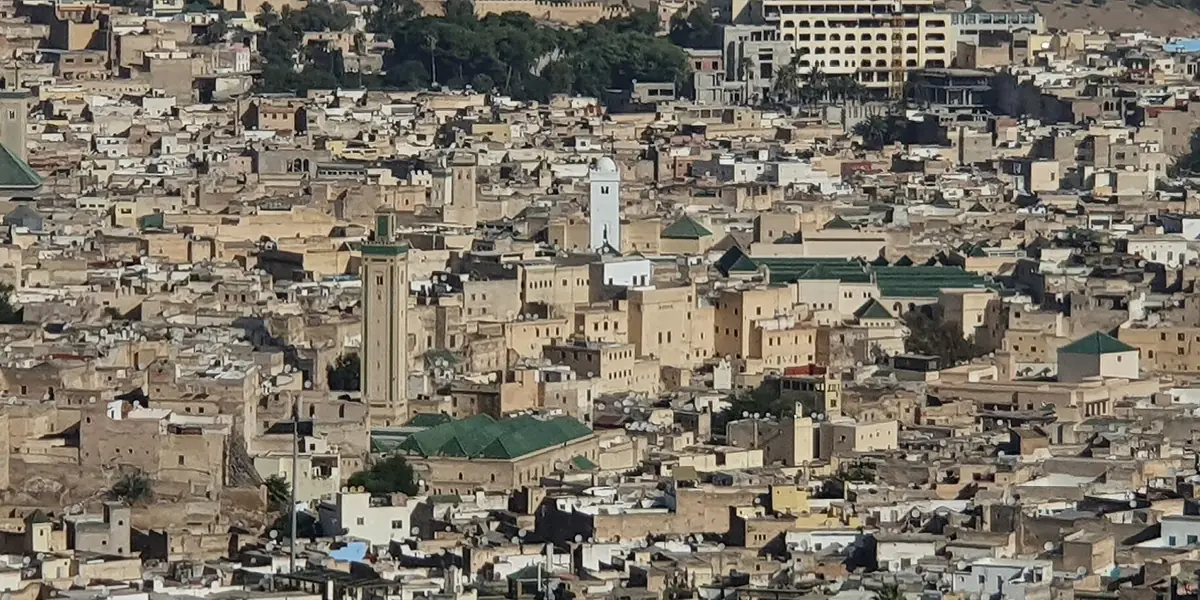
Photo: View of Medina of Fez by Yair Haklai, CC BY-SA 4.0, via Wikimedia Commons. Resized and cropped.

The Medina of Fez is on the UNESCO World Heritage List, inscribed in 1981. UNESCO's description gives a clear short history of how it grew, which makes a useful guide before you walk it. Everything below comes from that description unless noted.
Two towns, then one
UNESCO says the capital was founded by the Idrisid dynasty between 789 and 808, and that the original town had two large fortified quarters separated by the Fez wadi: the Andalous and the Kairouanais banks. In the 11th century the Almoravids joined the town inside a single rampart. Under the Almohads, in the 12th and 13th centuries, the original town (Fez el-Bali) reached its present size.
Under the Merinids a new town, Fez Jedid, was founded in 1276 to the west. UNESCO says it holds the royal palace, the army headquarters, fortifications and residential areas. Fez reached its height in the 13th and 14th centuries under the Merinids, when it replaced Marrakech as capital of the kingdom. Although the political capital moved to Rabat in 1912, Fez kept its role as the cultural and spiritual centre of the country.
Why it is on the list
UNESCO calls the medina one of the most extensive and best conserved historic towns of the Arab-Muslim world. It says the unpaved urban space keeps most of its original functions, and that building and decoration skills developed over more than ten centuries are still alive.
It names two reasons for the listing. First, the medina is a living witness to a city that influenced architecture, monumental arts and town planning from the 12th to the 15th centuries in North Africa, Andalusia and Sub-Saharan Africa, and Fez Jedid was inspired by the earlier town-planning model of Marrakech. Second, it is an outstanding example of a medieval town created in the first centuries of Islamisation of Morocco, with a high density of religious, civil and military monuments.
What UNESCO flags as problems
In its 2009 assessment UNESCO says the urban fabric has stayed remarkably homogenous and intact. The main problems it notes are deteriorating buildings and an over-populated area, and it says the land around the medina should remain a non-construction zone because it is vulnerable to uncontrolled urban development. It also records a Development Plan for the Medina adopted in 2001 and re-evaluated every ten years, and a programme to deal with houses at risk of collapse.
Visiting
The medina is large and the lanes do not follow a grid, so many visitors book a guide for the first day. Check opening times for individual sites on the day, as they can change.
Source: UNESCO World Heritage Centre, Medina of Fez, read November 25, 2026.