
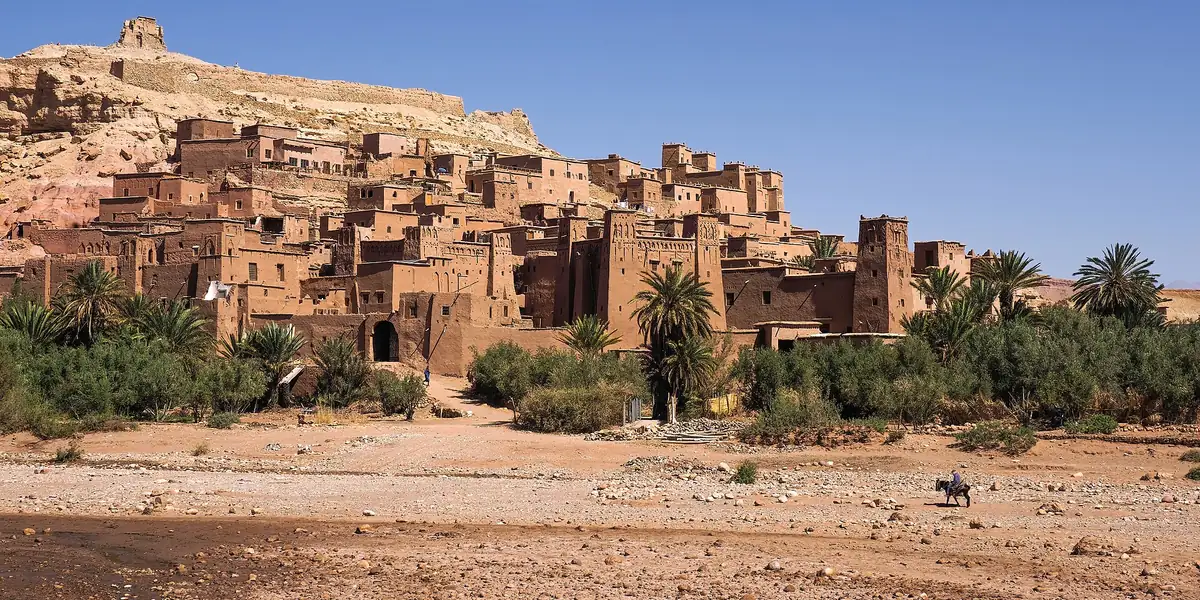
Photo: Ksar Aït Benhaddou by Petar Milošević, CC BY-SA 4.0, via Wikimedia Commons. Resized and cropped.

Most guides to Aït Benhaddou list what to see. This one asks a different question: how does a village made of earth survive for centuries? The answers come from UNESCO's description of the Ksar of Ait-Ben-Haddou, inscribed on the World Heritage List in 1987.
A trading post, not only a village
UNESCO says the ksar was one of many trading posts on the commercial route linking ancient Sudan to Marrakesh by the Dra Valley and the Tizi-n'Telouet Pass. It sits in the foothills on the southern slopes of the High Atlas, in the Province of Ouarzazate, and is described as the most famous ksar of the Ounila Valley.
How the ksar is laid out
Inside defensive walls reinforced by corner towers, and entered through a baffle gate, the living quarters form a compact grouping, closed and suspended. UNESCO lists the shared spaces: a mosque, a public square, grain threshing areas outside the ramparts, a fortification and a loft at the top of the village, a caravanserai, two cemeteries (Muslim and Jewish) and the sanctuary of the saint Sidi Ali or Amer.
The houses range from modest dwellings to buildings that look like small urban castles, with high corner towers and upper sections decorated with clay brick motifs. UNESCO calls the ksar a perfect synthesis of the earthen architecture of the pre-Saharan regions of Morocco, and says it shows the main types of earthen building used from the 17th century in the valleys of the Dra, Todgha, Dadès and Souss.
Earth and wood, and what did not work
In its 2009 assessment UNESCO says the construction materials are still earth and wood. It adds that attempts to introduce cement were unsuccessful, and that attention is paid to keeping wooden doors and windows along the lanes rather than metal ones. The larger houses in the lower part of the village, with well conserved decorative motifs, are regularly maintained.
Why upkeep decides everything
UNESCO is clear that earthen buildings are very vulnerable. It points to a lack of maintenance and repair since inhabitants left the ksar, and says CERKAS, the Centre for the conservation and rehabilitation of the architectural heritage of the Atlas and sub-Atlas zones, finds visual integrity difficult to monitor. It also describes the ksar as the record of a traditional way of living that has become vulnerable to socio-economic and cultural change.
How it is managed
UNESCO records that the site is protected under Law 22-80, that a five-year plan covered 2007 to 2012, and that two committees take part in its management. These are UNESCO's 2009 statements, so check current conservation news before treating them as today's situation.
If you go
Earthen walls are fragile, so stay on the paths. Trips that include Aït Benhaddou are listed on Viator, with live price and availability on each listing.
Search Aït Benhaddou tours on Mrocco
Source: UNESCO World Heritage Centre, Ksar of Ait-Ben-Haddou, read November 25, 2026.